


Syllabus: GS2/IR
Context
- India and Qatar reviewed their bilateral relations during the 6th round of Foreign Office Consultations.
Brief on India-Qatar Relations
- Establishment of Relations: India’s diplomatic relations with Qatar were established in 1973. The year 2023 marked the 50th anniversary of establishment of diplomatic relations.
- Strategic Partnership: In 2025, India and Qatar have signed an agreement to elevate their ties to the level of a strategic partnership.
- India currently has strategic partnerships with four other members of the Gulf Cooperation Council – the United Arab Emirates (UAE), Saudi Arabia, Oman, and Kuwait.
- Economic and Trade Relations: In FY 2025-26, India’s bilateral trade with Qatar stood at USD 13.91 billion. India’s export to Qatar during the period was USD 1.62 billion and India’s imports from Qatar were USD 12.29 billion.
- Two sides also signed a double taxation avoidance treaty and also planned on doubling their trade by 2030.
- Energy: Qatar is the largest supplier of LNG to India (10.86 MMT for US$ 5.61 billion in FY 2025-26), it is also the largest supplier of LPG to India (4.58 MMT for US$ 2.67 billion in Financial Year 2025-26).
- In FY 2025-26, the total bilateral hydrocarbon trade between the countries amounted to US$ 10.81 billion, accounting for 77.71% of overall bilateral trade.
- In 2024, QatarEnergy and Petronet LNG signed a 20-year agreement for the supply of 7.5 million tonnes of LNG annually, beginning in 2028.
- Defence: The India-Qatar Defence Cooperation Agreement was signed in 2008 and extended for five years in 2018, it is managed through the Joint Defence Cooperation Committee (JDCC).
- India participates in the biennial Doha International Maritime Defence Exhibition and Conference (DIMDEX).
- Exercise Zair-Al-Bahr is a joint naval exercise between the Indian Navy and the Qatar Emiri Naval Force (QENF).
- Labor and Diaspora: Around 830,000 Indians in Qatar is testament to the close people-to-people ties that continue to nurture the cultural bonds.
- The Indian diaspora in Qatar plays a crucial role in the country’s development, particularly in construction and other sectors.
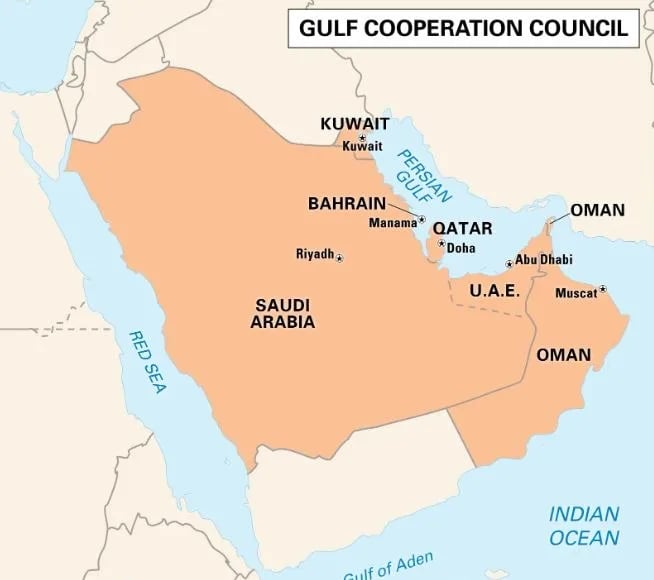
- Regional Cooperation: The Gulf Cooperation Council (GCC) is a political and economic alliance of six Middle Eastern countries—Saudi Arabia, Kuwait, the United Arab Emirates, Qatar, Bahrain, and Oman. It was established in 1981.
- India engages regularly with GCC and aims to deepen its relationship with the GCC.
Gulf Region
- The Gulf Region typically refers to the countries surrounding the Persian Gulf in the Middle East.
- It includes nations like Saudi Arabia, Kuwait, Bahrain, Qatar, Oman, and the United Arab Emirates (UAE).
- This region is known for its vast oil reserves, which have significantly influenced global economics and politics.
Significance of Qatar for India
- Energy Security: Qatar is a major supplier of liquefied natural gas (LNG) to India. These imports support India’s electricity generation, fertiliser production and industrial requirements.
- Indian Diaspora: A large Indian community lives and works in Qatar, contributing to its economy and sending remittances to India. Their safety, welfare and labour rights are important bilateral concerns.
- Maritime Security: Qatar’s location near the Strait of Hormuz, a key route for global energy supplies, makes regional stability important for India’s energy imports and commercial shipping.
- Regional Diplomacy: Qatar maintains diplomatic channels with various regional and international actors. Its engagement can support dialogue on conflicts, de-escalation and the protection of Indian interests in West Asia.
Challenges/Concerns
- The Hamas–Israel war and shipping attacks in the Red Sea affect India’s energy security and economic growth.
- India remains cautious in Middle Eastern politics, balancing relations with the Gulf, Iran, and Israel.
- Limited Trade Diversification: Bilateral trade remains significantly influenced by hydrocarbons, leaving scope to expand cooperation in manufacturing, technology, services and other non-energy sectors.
- Delay in Connectivity Projects: The conflict has delayed progress for the I2U2 group since 2023.
- India urges economic initiatives like I2U2 and IMEC to progress despite the conflict.
- FTAs with GCC: Delays in finalizing the India–GCC Free Trade Agreement (FTA) due to changes in the GCC’s trade negotiator. Reaching an agreement that satisfies all GCC states remains a key challenge.
Way Forward
- Qatar is a key partner in India’s pursuit of energy security, economic diversification and stronger engagement with West Asia.
- Strengthening institutional frameworks, expanding economic complementarities, and ensuring the welfare of the Indian community will be key to future-proofing this vital West Asian partnership.
Source: MEA
Previous article
News In Short 09-10-2026
Next article
3rd International Bharat 6G Symposium 2026
